Continuing the series on how to make decisions, I’m going to focus on the “Models” item in the mind map, beginning with Language as the topic.
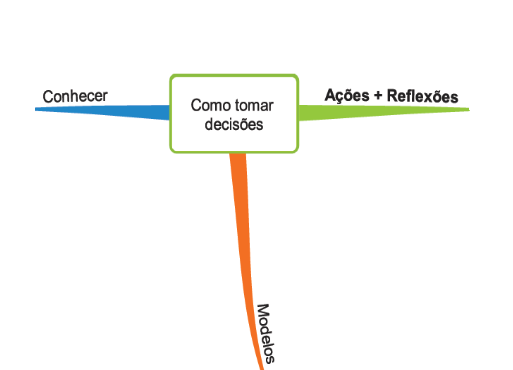
In this text, “models” means references, principles, perspectives, and more detailed explanations drawn from science (the exact, biomedical, or human sciences) or philosophy that can help with the discussion I’m proposing: how to make decisions more effectively and flexibly.
Because our interaction with the world—whether for entertainment, work, politics, faith, or other reasons—depends on our ability to relate to one another through language, I decided to begin this section on models by exploring this universal ability in more detail.
Before we get to the definitions, here is a simplified overview of the different conceptions of language:
- Language as the expression of thought: In this view, language is limited to translating thought; utterance is monologic and individual. Thought is what matters most. This view is inherited from Plato’s dualist philosophy, which divided the world into two parts: the sensible, material, physical world, regarded as an illusion and less important; and the knowable, mental, spiritual, metaphysical world, regarded as more important and as a path to the true essence of things and/or spiritual fulfillment. This dualist way of seeing the world reached its philosophical high point in the Cartesian theory developed by René Descartes, author of the famous phrase “I think, therefore I am.” In this view, language is clearly seen as the result of well-developed thought.
- Language as a means of communication: This second view grew out of a theory of language that made it possible to study language independently of philosophy. Developed by Saussure, this theory became known as structuralism. This view does not take social context into account. It divides language into langue and parole. Langue is the more important part: it is seen as a code, and it has a social character in the sense that everyone communicating uses the same set of codes. Parole is merely a manifestation of this system of codes. Despite its scientific character, this view clearly maintains a dualism between langue and parole and emphasizes langue as the more important. That is why Marcos Bagno, in Pedagogical Grammar of Brazilian Portuguese, calls this view structuralist Platonism: Plato’s dualist perspective remains influential.
- Language as a form or process of verbal interaction: This view originated with the Russian thinker Mikhail Bakhtin. It does away with dualism and proposes a monist view of language, in which the dichotomy between langue and parole does not exist. Here, system and use, grammar and discourse, the linguistic and the social make up an inseparable whole. They are so inseparable that when they are separated, language ceases to be language—just as separating oxygen from hydrogen in water means the result is no longer water. Verbal interaction is essential to this view. It is also a dialogic view of language, in which every utterance is a dialogue, every text is a conversation or a response or a question or an interaction with another text. I also want to emphasize that this view understands language as an expression of thought and accepts that it is also a means of communication. But it makes clear that language is more complex than that: its essence can only be understood if we analyze it as a process of verbal interaction and meaning-making—that is, by observing it in use.
Understanding these conceptions matters because our actions and decisions are made according to our conception of language, or, in other words, according to the limits of how we see language. If I know only the first view—that language is the expression of thought—then in a classroom I will tend to give little importance to interaction with students and to the feedback discussions can provide to help me improve as a teacher. In that case, I’ll choose to perpetuate the formula “teacher speaks, student listens,” a formula that a country such as Finland, which is known for its education system, abandoned decades ago. In Finland, classes follow the principle that less is more. The teacher presents the material for about 40% of the time, while discussion and interaction with the class take up about 60%. A team of teachers observes each class from the back of the room; as soon as the lesson ends, the teacher receives tips from more experienced colleagues on how to improve it. This creates an ongoing cycle of interaction focused on learning. This perspective recognizes that language is an expression of thought and a means of communication, but not only those things: it also recognizes language as a form of verbal interaction, and that interaction as the essential point in the student–teacher relationship, since it helps develop proactive people with a full capacity to contribute to the development of our society.
Another example of this third conception of language in practice is Khan Academy, an initiative by Salman Khan to create videos for teaching mathematics. It expanded to several other subjects and can be accessed free of charge by anyone over the Internet. Many of these videos were translated into Portuguese by the Lemann Foundation and are being used in public schools in São Paulo. These videos reverse the classroom model described in the previous paragraph. Students watch the videos at home and do the exercises in class with the teacher, increasing the amount of student–teacher interaction.
Here are some definitions inspired by the third conception of language:
- Language is the capacity to create meaning. Language is manifested—that is, meaning is created—verbally and nonverbally. At the moment of utterance, this externally expressed component of meaning comes to occupy a finite space in which meaning is manifested, known as a text.
- Text is the place where meaning is materialized and manifested through language—that is, through the capacity to create meaning, verbally or nonverbally. Once meaning has been materialized as a text, another person can read and interpret it.
- This manifestation of meaning through language is structured according to a particular set of rules. That set of rules is called a language system. Verbal communication depends on the participants understanding these rules.
Now that we’ve arrived at language systems, let’s talk about grammar, whose focus is precisely the structuring of language: this set of rules that changes over the years as a result of cultural interactions.
There are several types of grammar. For this text, I’ll highlight three main types, based on Travaglia’s conceptions of grammar:
- Prescriptive grammar: The first grammar was created in Alexandria. Alexandrian philologists noticed that ancient documents differed from everyday Greek. They saw this as a problem and created a set of rules to address it. The oldest recorded grammar is the Téchnē Grammatiké (Art of Grammar), written by Dionysius Thrax (170–90 BCE) in Alexandria. Prescriptive grammar arose in this context.
- Descriptive grammar: It describes and records the linguistic units and categories found in a particular variety of a language at a particular point in time. It does not try to assign value to what is or is not important; it simply makes available what exists at that moment, including linguistic variations, which are not very welcome in the prescriptive approach.
- Internalized grammar: Also known as a speaker’s internalized linguistic competence, it is the set of rules speakers have mastered, which allows them to use the language normally.
To wrap up the topic of grammar, Irandé, in her book Portuguese Class: Encounter and Interaction, points out that grammar can be divided into:
- Rules of grammar: These are intended for use. For example, what rules should be followed to produce and read an abstract, a news story, a review, and so on?
- Grammatical terminology: This focuses on describing the elements of a language.
The criticism of teaching that focuses too heavily on grammatical terminology is that it is not useful simply to know the names of conjunctions; what matters is knowing the meanings they express. Learning the rules of grammar is more important because those rules enable us to use language more effectively.
What can we take from this discussion in the context of decision-making?
The first point is to recognize verbal interaction as the central focus of this study of language. This helps us understand that mastering a range of text genres gives citizens a broader repertoire of tools and skills for making more informed decisions. For example, imagine having to deal with legal matters overnight. Legal texts use specialized terminology and include a large number of laws. It is difficult, almost impossible, to acquire that skill overnight. Of course, lawyers are there to help. But what I mean is that nothing prevents each citizen from trying to gain at least a general understanding of this and other text genres, because that enables them to take a more active and effective role in solving problems. At the same time, recalling the line from the Titãs song “Comida” (“Food”): “We don’t want just food; we want food, fun, and art.” This also means we should engage with other genres that do not follow the standard language, since the standard language cannot capture the dynamic, flexible, creative, and poetic nature of human beings. These other genres should be appreciated for their own language, not compared with the standard. The aim is to explore and admire humanity’s ability to express itself through language and its variations. These variations are neither better nor worse than the standard; they are simply variations, a characteristic of a language that is always changing—not for better or worse, just changing. Appreciating, learning about, and experiencing genres that use linguistic variation is, above all, a way of recognizing the heterogeneous nature of human beings and society. To explore linguistic variation in greater depth, consult Irandé Antunes and Marcos Bagno, among other authors, as listed in the references at the end of this text.
My suggestion is that you keep learning throughout your life and develop new language skills through a range of text genres.
The second point I want to raise is the importance of dissolving distorted explanations of reality that remain deeply embedded in our society. I’m referring to dualism. This perspective tends to serve as a foundation for various forms of prejudice around us. In the 2012 film Lincoln, directed by Steven Spielberg, we can see the following dichotomies created by the dualism entrenched in the culture of the United States at the time:
- White vs. Black — Black people were enslaved and were the private property of white people.
- Man vs. Woman — women did not have the right to vote or autonomy in society.
The example above shows Plato’s perspective being used to support a minority’s domination over everyone else, precisely because the dualist view elevates the first term (White and Man) and devalues the second (Black and Woman).
Recently, in a bathroom at a Brazilian university, I saw this sign: “Reserved for professors and staff.”
At first glance it seems like an ordinary sentence, but on closer examination we can see the same dualism that began with Plato, still embedded in this academic setting.
The dichotomy in this setting is Professor vs. Staff. The sentence clearly carries the full Platonic weight of elevating the first term, “professors,” and devaluing the second, “staff.”
Let’s dissolve the harmful dualist Platonism in this sign:
- An employee is a person who performs a role in a workplace. In this sentence, a professor is an employee who teaches. An administrative technician performs a different role, dealing with bureaucratic matters not directly related to the classroom. The support and general-services team performs yet another role, keeping the institutional environment ready for use through cleaning and other services.
- The purpose of a university is to provide society with texts containing scientific and philosophical knowledge, because this knowledge is recognized as offering a less distorted and somewhat more detailed view of reality. Therefore, all university workers should support this purpose. The institution needs employees who teach and employees who manage, or even employees who perform both management and teaching duties. To function effectively, it also needs employees who handle cleaning and other services. No one is better than anyone else; these are interdependent roles working toward the shared goal of serving society.
- The final wording would be: “Reserved for employees: professors, administrative technicians, support staff, and general-services staff.” This final sentence dissolves the dualism and plants a seed for a monist perspective, in which the parts make sense only through their interrelationships.
Here’s another tip: whenever you notice this dualist view of reality, try to dissolve it as soon as possible. This view prevents us from making decisions that treat people with respect and fairness.
The third point is the importance of having at least a basic understanding of history and exploring the subject or problem to be solved in greater depth. In the context of language, it is easy to understand that if I study grammar rules for a civil-service exam, I am studying prescriptive grammar. Although it has influence and practical uses, it is not the only way to deal with language. So, yes, I can study for the exam, but that does not give me the right to look down on someone who has not mastered 100% of that standard—a standard with many features that have fallen out of use in everyday life because language is dynamic. So, see prescriptive grammar in proportion to its actual value: a static snapshot of a language, validated by the state as a standard to be followed in certain contexts—no more and no less. This explanation leaves no opening for the dualism that we have seen can serve as a foundation for prejudice.
My advice is never to settle for superficial answers. Keep going and learn the history of the subject you’re examining; try to find the root of the problem. Yes, it’s tiring, but at the same time it’s liberating.
I’d like to give special thanks to Gilberto de Oliveira and Ana Carvalho, whose discussions helped generate several of the ideas in this text.
Best wishes, and see you in the next post.
For further reading, here are the references:
ANTUNES, Irandé. Beyond Grammar: Toward Language Teaching Without Stones in the Way. 3rd ed. São Paulo: Parábola, 2008.
ANTUNES, Irandé. Portuguese Class: Encounter and Interaction. São Paulo: Parábola Editorial, 2003.
BAGNO, Marcos. Linguistic Prejudice: What It Is and How It Is Done. 21st ed. São Paulo: Loyola, 1999.
BAGNO, Marcos. Pedagogical Grammar of Brazilian Portuguese. São Paulo: Parábola Editorial, 2011.
BAGNO, Marcos; STUBBS, Michael; and GAGNÉ, Gilles (eds.). Mother Tongue: Literacy, Variation & Teaching. São Paulo: Parábola, 2002, pp. 13–84.
BORTONI-RICARDO, Stella Maris. Mother-Tongue Education: Sociolinguistics in the Classroom. 5th reprint. São Paulo: Parábola Editorial, 2004.
OLIVEIRA, Gilberto de. “Conceptions of Language: Some Descriptions.” In: SILVA, Francisco Paulo da (ed.). Journeys of Meaning and Other Questions of Language. Mossoró: Queima-Bucha, 2008.
SÉRGIO, Ricardo. “The First Grammar: Studies & Grammatical Notes.” Available at http://www.recantodasletras.com.br/gramatica/2482552. Accessed March 2013.
TRAVAGLIA, Luiz Carlos. Grammar and Interaction: A Proposal for Teaching Grammar in the First and Second Levels. 5th ed. São Paulo: Cortez, 2000.