I began the first post by discussing the most important part: actions and reflection. In this second part, I’ll say more about the item knowledge. The diagram showing the decision-making process appears below:
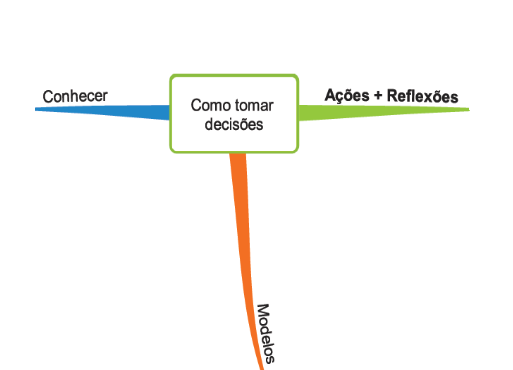
If I could sum up this post in one sentence, I’d say: we need to fight to dissolve the source of most problems: ignorance.
We make and repeat mistakes, often without even knowing whether we’re making them. There’s no magic pill or easy way to solve this. We need to learn; we need the patience to dig and discover the origin, nature, and reasons behind things. We need to understand our world and its characteristics:
- complex
- constantly changing
- made up of social networks and their rules
In my posts, whenever I can, I translate historical texts about technology: The First Robot, The Beginning of the Digital Era, and, more recently, A Brief History of the Internet. My main motivation is my enthusiasm for technology, but I also know that this kind of exercise in continuous, in-depth learning is extremely important. In the case of these historical texts, I noticed the difficulties professionals of that time faced. Today everything is a click away; it wasn’t before. Once I understood that the ease I enjoy today is possible only because some people in the past did complex work, I became more humble and respectful. I realized I’m just one “little ant” among thousands, part of something more complex, and that I need to learn to interact positively with it.
However, it’s not enough to know what is around us. We also need to know ourselves—our qualities, characteristics, weaknesses, limits, abilities, and moods. I think this is the hardest part today. We are led (at least in our Western culture) to look only outward and leave ourselves out of the search for knowledge.
Each person is unique, but I’ll describe some more universal characteristics we have in common:
-
We are what we repeatedly do. This phrase lets me predict my future with some accuracy, because the future is a consequence of what we repeat in the present. Someone who sees a successful person and thinks it was easy has no idea how much effort and persistence it took to reach that level. Another example is the professional who “coasts” at work and thinks they’re being “clever.” The phrase is clear: such a professional has no idea that by repeating mediocre actions, they are becoming a mediocre person and will have difficulty overcoming more complex situations. As a result, they lose opportunities and become marginalized—not because of others, but because of their own actions. Remember: a bright future depends on the sum of small, consistent actions in the present. I’m not saying to do things at any cost, become a workaholic, or live under tension—not at all. I’m only saying that we need to make an individual commitment to continuous improvement.
-
We create a partial, indirect image of reality. We access reality and objects indirectly and partially. As we learn, our senses help us form a distorted image of reality, and that image will never be the same as reality itself because we are not omniscient. We gradually improve our knowledge through experimentation and indirectly refine the internal image we create of the world. The more we improve this internal image of the world and ourselves, the better we become at making sound decisions.
-
Social rules are generally stronger than individual will. I’ll discuss three examples:
-
Whenever you go against a company’s culture, you lose. Max Gehringer often talks about the need to adapt to a company’s culture. It’s simple: if the rule in a workplace is to wear long pants, and there’s no compelling reason otherwise, don’t try to show up in shorts. You’ll gain nothing, and you’ll be called out. Going against an environment’s culture is not the most effective way to reach an individual goal. If wearing shorts is very important to you, gradually look for an environment whose culture allows it, and then act. The point is not to erase yourself because of your surroundings. It is to know what you like and find an environment that accepts it. Remember, too, that there will always be some limits, and limits help us live together with a minimum of civility.
-
Society overvalues the left (rational) side of the brain. We are bombarded with encouragement to exercise the brain’s cognitive side. Of course, cognition is essential; without it I couldn’t write this text. But when we overuse one side, we underuse the other—the side associated with a broad, holistic view of the whole. The key point is that we make better decisions when our daily activities exercise both the left and right sides of the brain. One example is complementing our studies with a sport or artistic activities. Learn more: post: Drawing on the Right Side of the Brain. Book: My Stroke of Insight: A Brain Scientist’s Personal Journey by Jill Bolte Taylor.
-
We tend to follow the majority opinion, even when we know it is wrong. We unconsciously tend to think it is better to be wrong alongside the majority than right on our own. We need to become aware of this tendency and make important decisions with a clear understanding of why we are making them—and ensure that this reason aligns with our goals and individual personality. If you let this tendency guide your important decisions, it will be very difficult to achieve your goals and live a more enthusiastic life. Learn more about the bandwagon effect.
-
-
We are rational beings, but also emotional, and we become attached easily. The point is to become aware of your emotions and whether they are helping you achieve your goals. There’s no one-size-fits-all formula for this. Every individual is unique in this regard. If we follow only our emotions, we may be committing injustices without knowing it. On the other hand, if we overdo rationality, we become cold and, I would say, even inhumane. We cannot allow ourselves to set goals that make us inhuman, so even without a map, we need to seek balance and treat that search for balance as an individual responsibility.
-
Out of ignorance, we tend to avoid what we think is bad and cling to what we think is good. I’m returning to the first sentence of this text: “Ignorance is the source of most problems.” As I said, there is an interface between the world and our minds. On the mental level, I discussed the distorted image of reality we create and the need to keep improving it. On the biochemical level, there is another interface: sensations. Every interaction between our senses and the outside world produces a sensation in our bodies, which can be pleasant, unpleasant, or neutral (tension, tingling, pain, cold, heat, and so on). A sensation is not permanent: it arises, occurs, and passes. That is the nature of sensation. Our ignorance begins when we cling to pleasant sensations. When that attachment becomes intense, it can create a prison in our bodies that we call addiction in the case of chemicals, or compulsive behavior when we act without restraint to get what we want at any cost. On the other hand, when we live in conflict, we tend to develop aversion to the situation and the environment. This aversion creates tension in the body, which can build up until we live in panic and need professional help. The cure is to understand this mechanism and try to act in a balanced way in life. It is a difficult process, but possible. We need to escape the slavery of sensations and live according to a greater purpose. This does not mean erasing ourselves, but acting in a balanced way in the face of life’s difficulties. (For more on this subject, see the book Vipassana Meditation: The Art of Living, according to S. N. Goenka.)
-
We are creatures of habit and tend to have difficulty with change. Change is undeniable and inevitable; it is part of the nature of our constantly evolving world. We need to adapt to change. If possible, accept it as a way to improve your skills and your view of the world. Don’t see change as a risk; see it as an opportunity. Ask yourself what you can learn from it. Although we are creatures of habit, we are free to choose and change our habits. Of course, it’s hard to change something we’ve repeated often, but it isn’t impossible. That’s why it’s important to develop good habits early on; bad habits are like weeds that destroy a crop. Bad habits keep us from becoming fully fulfilled people. We are creatures of habit, but we should choose healthy, sustainable habits.
I’ve discussed the importance of understanding the world and ourselves, and tried to make all of this a little less complicated. But we also need to take certain steps that, in my opinion, can help us balance everyday life and solve its problems:
-
Learn to live with differences. Each person has a unique personality. Often they have an opinion opposite to mine, but I have to respect and learn to live with opposing views. An opposing opinion doesn’t mean mine is right; it only means it is different. Without the ability to live with and respect differences, we won’t get very far.
-
Learn to say no. It’s impossible to please everyone. Your goal can’t be to please others or sacrifice yourself for them. If you sacrifice yourself when there is no compelling reason, you reinforce the distorted idea that those people are better than you. This creates problems for both you and the person you sacrifice yourself for: you become exhausted, and the other person develops bad habits such as excessive dependence and a lack of initiative. So “no” really is useful. We need to set healthy limits; if you don’t set limits, the world around you will impose things you don’t like. Never turn “no” into “maybe.” No is necessary, useful, and healthy. (Learn more about this in “The 3 Types of Employees,” by Max Gehringer.)
-
Recognize the difference between persistence and stubbornness. To explain this difference, I like to quote Einstein: “Insanity is doing the same thing over and over again and expecting different results.” When you realize a particular action is not producing positive results, change it. When your action has been validated by positive results, you can persist—repeat and improve it—until you achieve your larger goal. Persistence should only be put into practice after a positive response (the validation of an idea). Another way to spot stubbornness is that it becomes a cycle, a trap; it doesn’t flow. The action becomes mechanical and produces no results. Get out of that cycle.
-
Learn to live between the public and private spheres. We need to find balance between these two spheres, which often diverge. But I always like to remember the saying: praise in public, criticize in private. No one likes to see their shortcomings discussed in a public forum; it complicates relationships and often makes them unbearable. As with learning to say no, try to say it privately and individually whenever possible. A public “no” is harsh, though every case is different.
This text was made possible in part by my experience and also by research into books and by various people who have one thing in common: they question the status quo. One thing I’ve discovered is that you can’t improve by always doing what the majority says is right. We need to question ready-made ideas. It’s impossible to keep growing and making good decisions using canned ideas. So here’s a tip: make a list of people who question the status quo and take inspiration from them, until you can follow your own path.
I believe every human being was born to shine and to use their abilities fully and harmoniously. Everything I’ve discussed in this text aims to contribute to a more mature view of the world, society, and ourselves. I believe this mature perspective enables us to make sounder, more flexible, and, in my opinion, more humane decisions.
Best wishes, and see you in the next post in the series on how to make decisions.