Hi! In this post I’m going to talk about a topic I’m very curious about and have been working to improve on over the years, through both reading and personal experience: how to make decisions.
For teaching purposes, I suggest simplifying decision-making into three points:
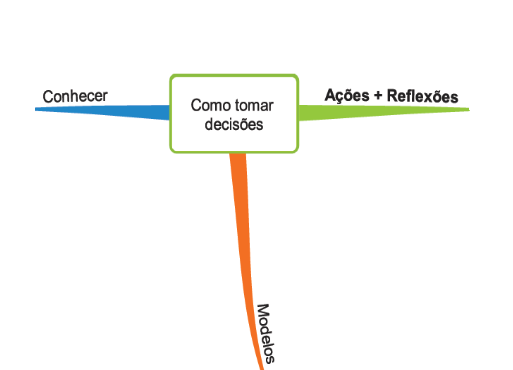
- Actions + Reflection: This is the main point in my view. It means pragmatic learning—improving through the successes and mistakes of everyday life.
- Knowledge: When making decisions, it’s necessary to understand the context we’re in, ourselves, and the nature of things in depth. We should also seek inspiration from people who question the status quo and think outside the box.
- Models: The Golden Circle, the 80/20 rule, and network science are resources that can help someone who has practical experience (item 1) and keeps up to date (item 2).
Before discussing problem-solving itself, I want to call attention to two essential points:
- The need to have a purpose in life. What are my talents? Am I developing them well? Where do I want to go? What are my goals? Why do I get up early every day and do what I do? Are my daily actions taking me toward my goal? Are they consistent with my purpose in life? Without a purpose, we end up leading mediocre lives, hiding behind masks, living for appearances and status—a gray, dull, submissive, joyless life. Purpose gives meaning to our daily actions. It gives us strength in the face of adversity.
- The awareness that we must take responsibility for our own successes and failures. Look in the mirror, and say and act on this statement: “I ALONE am responsible for my success and my failure.” Please, this is not self-help, arrogance, or selfishness. Without the awareness and daily practice of taking responsibility for your own life, it’s like spending your life walking on eggshells. In my opinion, it isn’t possible to make important decisions decisively without this foundation firmly in place.
In the post Let’s Honor Galileo, I talk a little about the scientific method: after Galileo, an idea making sense was no longer enough for it to be considered true; an experiment was needed to prove the hypothesis. Every idea, therefore, needs to be validated. No superficiality—we need to dig deep and put in the work.
Here’s a tip I like: Never settle for the first “why.” Ask as many questions as necessary to find the root of the problem. At the same time, be careful not to ruminate excessively; start acting as soon as you can.
In his book Problem Solving 101, Ken Watanabe divides the problem-solving process into four steps:
- Understand the current situation.
- Identify the root cause of the problem.
- Develop an effective action plan.
- Carry it out until the problem is solved, making any necessary changes.
The method above involves both thinking and action. Doing only one of the two gets you nowhere.
Now I’d like to introduce you to Maria:
Maria is a determined woman who knows where she wants to go. She enjoys playing the piano in her spare time and dreams of teaching music to underprivileged children. During the day, she works for a cosmetics company. One day, when she tried to print the monthly sales report, she couldn’t because of a printer problem. Being proactive, she immediately called the maintenance team to get a technical assessment. The technicians said the toner needed to be replaced and told her to check with the stockroom. When she got there, the person in charge said there were no toner cartridges available and told her to contact Purchasing to order one. At Purchasing, she was told that the quarterly budget had already been exceeded and that she would have to wait. She returned to her office and realized that she could print that day’s work in another room, but that relying on this every day would hurt productivity. In the meantime, she ran into the company director, who said, “Maria, I had to borrow your toner this morning. I put the one from my broken printer in its place. I could only let you know now because I was so busy.” Maria went back to her office relieved: she got her toner back and managed to print her report. But during her visits to the different departments, she had noticed that the company was going through a crisis. Thinking about it, she developed some ideas and, at the right moment, suggested that the company use a single networked printer and print only what was necessary. She also suggested using email to communicate and share documents. This initiative, along with others, made a significant contribution to helping the company weather the crisis and prosper.
In this example, while solving her immediate problem, Maria discovered something more serious. Even in the face of this bigger problem, she planned and suggested changes. She proactively moved through the four points mentioned above, alternating between reflection and action. She didn’t settle for the first answer; she investigated and sought to validate her questions. I think that point is clear. I don’t even need to say that Maria has well-defined dreams and takes responsibility for herself.
Best wishes, and see you in the next post in the series on how to make decisions.